




0
0
0
0
12 Essential KPIs That Your Vacation Rental Business Cannot succeed Without Controlling Them.
Why are they important?
A profitable business can still experience a cash crisis.
Revenue may have been recorded in the accounting system even though the money has not yet been received. At the same time, the company may need to pay owners, cleaners, employees, taxes and suppliers before platform settlements reach the bank.
Cash flow shows when money actually moves.
Available Cash shows whether the business can meet its immediate obligations.
These indicators help management avoid confusing accounting profit with liquidity. They are essential for payment planning, treasury forecasting, owner settlements and financial stability.
A professional vacation rental company should prepare a rolling cash flow forecast covering at least the next several weeks or months. The forecast should include expected booking collections, platform settlement dates, recurring expenses, owner payments and tax obligations.
Without cash flow control, growth itself can become a financial risk.
KPIs Must Be Connected, Not Analysed Separately
The real value of KPIs appears when they are analysed together.
High Occupancy Rate with low ADR may indicate underpricing.
High ADR with low occupancy may indicate weak demand, excessive pricing or poor distribution.
High RevPAR with low Operating Margin may reveal uncontrolled expenses.
Strong Total Revenue with weak Net Revenue may indicate excessive commissions, discounts or refunds.
High guest ratings with low direct bookings may indicate that the business is not converting satisfied guests into repeat customers.
Positive accounting profit with limited available cash may indicate delayed collections, excessive owner payments or poor treasury planning.
No single KPI provides a complete picture of the business.
The objective is to create a management system that connects commercial performance, operational efficiency, profitability and liquidity.
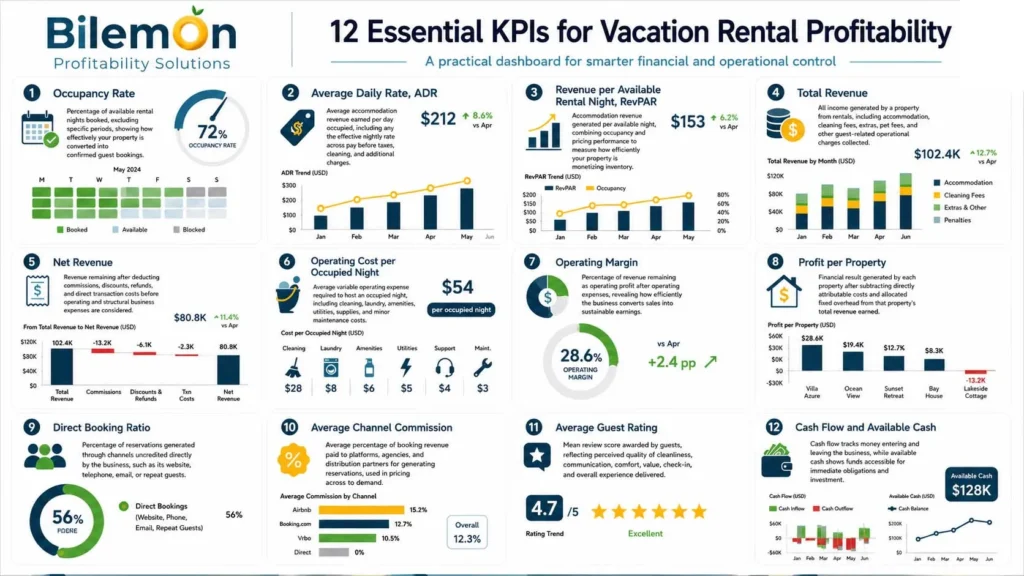
12 Essential KPIs
- Occupancy Rate: The percentage of available rental nights that have been occupied during a specific period, indicating how effectively inventory is converted into confirmed guest reservations.
- Average Daily Rate (ADR): The average revenue per room generated for each occupied night, indicating the actual price per night paid by guests before taxes, cleaning fees, and additional charges.
- Revenue per Available Night (RevPAN): Revenue generated per available night, which combines occupancy and pricing results to measure how efficiently a property monetizes its calendar.
- Total Revenue: All revenue generated by a property or portfolio, including room rates, cleaning fees, extras, penalties, and other guest-related operational charges that are billed.
- Net Revenue: Revenue remaining after deducting commissions, discounts, refunds, and direct transaction costs, before accounting for the business’s broader operating and overhead expenses.
- Operating Cost per Occupied Night: The average variable operating expense required to manage one occupied night, including housekeeping, laundry, utilities, supplies, support staff, and minor maintenance costs.
- B Operating Margin: The percentage of revenue that remains as operating profit after deducting operating expenses, which reveals how efficiently the business converts sales into sustainable profits.
- Profit per Location: The financial result generated by each location after subtracting directly attributable costs and allocated overhead expenses from the total revenue earned by that location.
- Percentage of Direct Bookings: The percentage of bookings generated through channels directly controlled by the business, such as its website, by phone, by email, or through repeat guests.
- Average commission per channel: The average percentage of booking revenue paid to platforms, agencies, and distribution partners for generating bookings and facilitating access to demand.
- Average guest rating: The average score given by guests in their reviews, reflecting the perceived quality in terms of cleanliness, communication, accuracy, comfort, value for money, check-in, and the overall experience provided.
- Cash flow and available cash: Cash flow tracks the money flowing into and out of the business, while available cash shows the funds that can be accessed to cover immediate obligations and operations.